
What is the Cost of Compliance with Building Regulations?
For a multi-story urban development in Kenya, statutory approvals are typically calculated as a percentage of your total project cost (derived from the Summary Bill of Quantities) or based on the total plinth area.
Here is the current breakdown of the specific levies, fees, and permits required by the three main regulatory bodies:
1. County Government Fees
County fees vary depending on the specific municipality (such as Nairobi City, Kiambu, or Mombasa), but they generally follow a standardized structure based on the building’s size and zoning:
- Building Plan Approval Fee: Usually calculated per square meter of the total plinth area, or as a percentage (often around 0.1% to 1%) of the estimated construction cost, depending on the county’s current finance act.
- Statutory Clearances: Flat-rate charges for Public Health Inspectorate clearance, municipal engineer site visits, and Fire Safety permits.
- Auxiliary Permits: Because you are building a storied structure in an urban center, you will also be billed for mandatory site permits. These include hoarding permits (for fencing the site), scaffolding permits, and excavation/earth disposal permits.
- PPA2 Form: A small fixed administrative fee is charged for the actual issuance of the PPA2 approval document.
2. NEMA Environmental License
The National Environment Management Authority (NEMA) charges a straightforward processing fee to review your Environmental Impact Assessment (EIA) and issue the license.
- The Statutory Rate: By law, the NEMA processing fee is set at 0.1% of the total project cost.
- Minimum Charge: The minimum fee payable is KSh 10,000.
- No Upper Cap: There is currently no maximum limit on this levy; it scales infinitely with the cost of your project.
- Important Distinction: This statutory fee is paid directly to NEMA via the eCitizen platform. It does not cover the separate professional fees you must pay the registered EIA Expert who conducts the field study, facilitates public participation, and writes the actual report.
3. NCA Construction Levy
The National Construction Authority (NCA) polices site safety and quality. They levy a charge on all commercial and large-scale residential developments before works can commence.
- The 0.5% Levy: Any construction project with a contract value exceeding KSh 5,000,000 attracts a mandatory construction levy of 0.5% of the total project value.
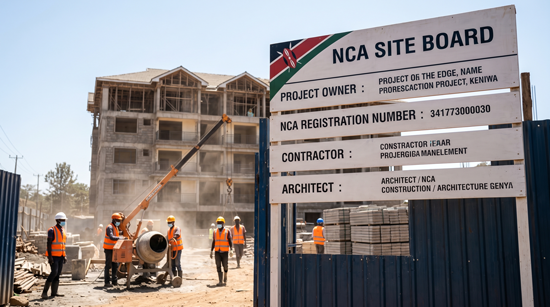
- Payment Responsibility: This levy is payable by the project owner/developer, not the contractor. It must be paid in full before the NCA issues the project Compliance Certificate and site board.
- Contractor Compliance: While you pay the project levy, the NCA will not accept your application unless your chosen contractor has paid their own annual practicing license renewal fees for the current financial year.
Statutory fees only cover the government processing and stamping. When budgeting for your compliance phase, ensure you also account for the professional fees of the Architect, Structural Engineer, Quantity Surveyor, and EIA Expert whose stamped documents are legally required to initiate these approval processes.