
Before you Break the Ground
Key Takeaways
- You must verify undisputed land ownership using a recent Title Deed, an official Land Search, a Survey Plan or RIM, and a Land Rates Clearance Certificate.
- The project design team must exclusively feature an Architect registered with BORAQS and a Structural Engineer registered with EBK to prevent county rejection.
- Multi-story urban developments require a comprehensive Environmental Impact Assessment (EIA) report and an official license from NEMA before securing final county blessings.
- The final legal requirement before contractor mobilization is an NCA Compliance Certificate, which demands your NEMA license, stamped BQs, PPA2 form, and the contractor’s valid NCA practicing license.
As a Quantity Surveyor, I often watch developers lose millions in holding costs and penalties simply because their approval paperwork stalled. Building a storied commercial or residential block in any Kenyan urban center today means navigating a strict regulatory web involving the county, environmental bodies, and construction authorities. Getting the compliance stage right makes the actual construction faster, safer, and far more predictable. Here is the exact, chronological roadmap you must follow before a single bag of cement is mixed on your site.
Clear the Land Paperwork
You cannot get building plan approval if you cannot prove undisputed ownership of the land. Before commissioning any designs, you are required to secure and verify several critical documents to clear any arrears and prove legal ownership.
Ensure you have a recent, verified Title Deed alongside an official Land Search. You will also need a Survey Plan or Registry Index Map (RIM). Finally, to prove that no outstanding property taxes or levies exist on the plot, you must obtain a Land Rates Clearance Certificate from the county.
Assemble Registered Professionals
Counties will instantly reject drawings submitted by unqualified individuals. Therefore, assembling a team with the correct mandatory certifications is vital.
Your core design team must include an Architect who is strictly registered with BORAQS; they will handle spatial, zoning, and aesthetic design. You also need a Structural Engineer registered with EBK to calculate load-bearing capacities and prove the building will stand safely. Additionally, a Quantity Surveyor must be hired to prepare the Summary Bill of Quantities (BQ), which is legally required later for fee assessments.
Secure Environmental and County Approvals
Before the county gives its final blessing, you must address the environmental impact of your multi-story urban development. This requires hiring a registered Environmental Impact Assessment (EIA) expert to compile a comprehensive report, submit it to the National Environment Management Authority (NEMA), and secure an EIA license.
Once cleared environmentally, submit your fully stamped architectural and structural drawings, ownership documents, and NEMA clearance to your local County Physical Planning Office. Officers from physical planning, public health, and environment will verify zoning laws, safety codes, and structural integrity. After these are passed and statutory fees (often charged per square meter) are paid, you receive stamped drawings and the PPA2 form, which serves as your official municipal building permit.
Register with the NCA
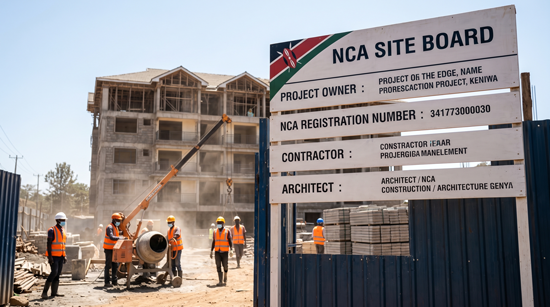
The final step before your contractors can mobilize to the site is registering with the National Construction Authority (NCA). The NCA polices construction quality, site safety, and contractor compliance.
To obtain your NCA Compliance Certificate, you must submit your PPA2 form, county-approved drawings, your NEMA license, and the BQ summary stamped by your Quantity Surveyor. You must also provide proof that your chosen contractor holds a valid NCA practicing license for the current financial year. Building approvals act as a critical risk management tool—protecting your investment from county demolition squads, shielding you from liability in site accidents, and ensuring the asset is structurally sound and insurable. Do not let your contractor mobilize until the NCA site board is firmly in place and visible.