
Planning Approval Process for Commercial Buildings
Key Takeaways
- Commercial building approvals in Kenya are governed by three main regulatory bodies: County Governments, the National Environment Management Authority (NEMA), and the National Construction Authority (NCA).
- Site preparation requires an Environmental Impact Assessment (EIA) License, involving expert fees between KES 50,000 and KES 150,000, plus a mandatory statutory fee of 0.1% of the total project cost.
- County building permits are processed digitally through platforms like NPDMS or e-DAMS, with baseline approval fees of 0.5% to 1%, which can be multiplied up to six times for commercial developments.
- Final compliance demands that all architectural and structural plans adhere to the National Building Code (NBC) 2024 and are submitted exclusively by registered professionals with valid BORAQS and EBK stamps.
Preparing Your Site and Securing Environmental Clearance
Before any physical construction begins, developers must lay the groundwork through land verification and environmental approvals. The first step is obtaining a physical survey plan from the Survey of Kenya, which requires requesting a Folio Registry number search to confirm land ownership and boundaries. Once the land is verified, developers must hire a licensed environmental expert to draft an Environmental Impact Assessment (EIA) report for NEMA. Projects are categorized into low, medium, or high-risk brackets, determining how complex the report needs to be. Although NEMA officially removed its EIA review fee in 2017, developers must still pay the expert’s preparation fees, which range from KES 50,000 to KES 150,000. Additionally, a standard national statutory fee equal to 0.1% of the total estimated project cost must be paid to secure the final EIA License.
Navigating County Approvals and Building Permits
After clearing the environmental requirements, the project moves to the county government for technical design approval. Developers must register on their specific county’s digital self-service portal, such as the Nairobi Planning and Development Management System (NPDMS) or Mombasa’s e-DAMS, to upload architectural plans and ownership documents. Evaluating these plans typically costs between 0.5% and 1% of the estimated construction cost. However, commercial projects often face special multipliers that can increase this baseline fee by up to six times compared to standard residential rates. Once the architectural designs are reviewed, structural plans are forwarded to the Development Control Section for further technical evaluation. After securing digital approvals across the board, developers must submit physical hard copies of their plans to the county authorities for official stamping.
Registering with the NCA and Handling Special Clearances
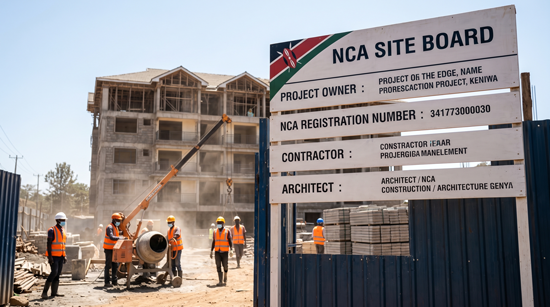
With county-stamped permits in hand, developers must register their commercial projects nationally. The main contractor is responsible for applying through the NCA’s Online Project Registration System (OPRS). If the commercial project is valued at over KES 5 million, developers must pay a mandatory statutory levy of 0.5% of the total project value to the NCA. The authority will then conduct a physical site visit to verify the project details before issuing a temporary construction certificate. Depending on the design and location, developers might also need specialized clearances. Buildings taller than 15 metres or located near flight paths require a “No Objection” certificate from the Kenya Civil Aviation Authority (KCAA). If the project involves drilling a borehole—which can cost up to KES 200,000 in licensing—or building within a 30-metre buffer of a water body, a permit from the Water Resources Authority (WRA) is required. Furthermore, in counties like Nairobi and Machakos, developers are increasingly expected to obtain a “Letter of No Objection” from local resident associations.
Working with Registered Professionals and Ensuring Code Compliance
The final hurdle in the approval process is ensuring that the project meets strict professional and safety standards. Under the National Building Code (NBC) 2024, only registered architects and engineers holding valid practicing licenses and official stamps from their respective boards (BORAQS and EBK) are legally allowed to submit building plans. These professionals must guarantee that the designs comply with all NBC 2024 requirements. This includes incorporating multi-hazard resilient designs to protect against earthquakes and soil risks, as well as meeting universal accessibility standards, such as installing public access ramps with a maximum gradient of 1:20. Finally, the project must align with County Spatial Plans and the site’s Infrastructure Development Level (IDL). The IDL ensures that the permissible plot coverage and building density do not exceed the capacity of the area’s available water, sewer, and electricity services.
Successfully navigating this multi-tiered regulatory process ensures that commercial developments in Kenya are legally sound, structurally safe, and adequately supported by local infrastructure. By systematically fulfilling the requirements of county planning departments, environmental authorities, and national construction regulators, developers can avoid costly delays, ensure compliance with modern accessibility and resilience standards, and confidently advance their projects from the design phase to active construction.